
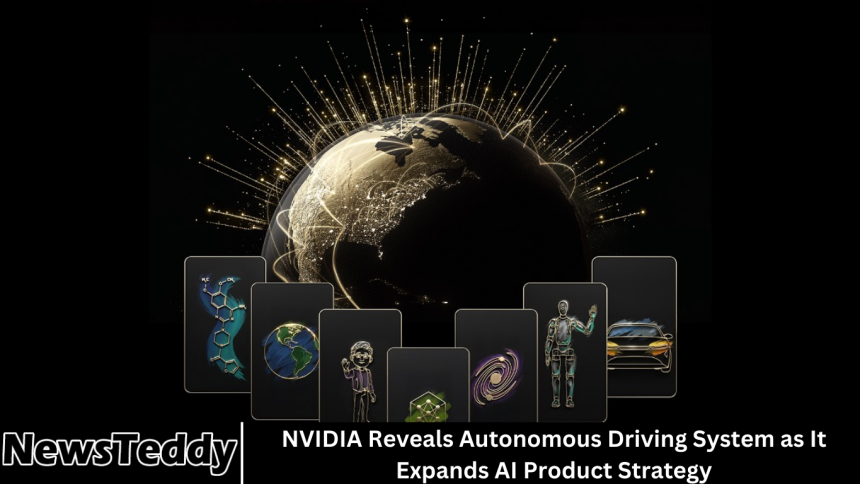
NVIDIA, a global leader in AI computing, has once again raised the bar with its latest autonomous driving system. This move highlights Nvidia’s strategy to expand AI capabilities across multiple industries, from automotive to robotics, cloud computing, and beyond.
The new system reflects Nvidia’s belief that autonomous vehicles will play a crucial role in the future of transportation, while also showcasing the company’s broader ambition: turning AI into a universal computing platform.
NVIDIA’s New Autonomous Driving System: What It Means
NVIDIA’s new autonomous driving system represents a major step forward in AI-driven mobility. The system combines advanced hardware, deep learning software, and real-time processing capabilities. This integration enables vehicles to perceive environments, make split-second decisions, and navigate complex road conditions without human intervention.
This new system is designed to meet demands from automakers and fleet operators who want scalable, safe, and reliable autonomous driving solutions. NVIDIA’s platform aims to deliver the speed, accuracy, and efficiency needed for commercial deployment.
More Read: Intel’s Panther Lake, Antler’s $510M Funding, and Other Top Stories Today
Key Features of Nvidia’s Autonomous Driving System
- Real-time perception using AI vision and sensor fusion
- High-performance computing with powerful GPU acceleration
- Advanced neural networks trained on massive datasets
- Safety-first architecture designed for redundancy and reliability
- Scalable software stack compatible with multiple vehicle models
- Continuous updates through cloud-based learning and improvements
These features combine to create a system capable of handling urban driving, highway cruising, and complex traffic scenarios.
AI Expansion Strategy: Beyond Cars
NVIDIA’s autonomous driving system is not an isolated product. It fits into a broader AI expansion strategy that targets multiple markets. NVIDIA’s goal is to make AI accessible across industries by offering a unified computing platform.
AI in Automotive
Autonomous driving remains one of the most ambitious AI applications. NVIDIA aims to provide automakers with tools that reduce development time, lower costs, and improve safety. The company’s system supports:
- Driver assistance
- Partial automation
- Full self-driving capabilities
Automakers can leverage Nvidia’s system to accelerate innovation while maintaining strict safety standards.
AI in Data Centers
NVIDIA’s AI hardware powers many of the world’s most advanced data centers. The company’s GPUs enable fast training and inference for deep learning models. NVIDIA’s autonomous driving system benefits from this same computing power, especially during model training.
AI in Robotics and Edge Computing
NVIDIA’s strategy extends to robotics and edge computing. The company’s hardware and software enable intelligent machines that operate in real-world environments. Autonomous vehicles share many technological similarities with industrial robots, including:
- Sensor integration
- Real-time decision-making
- Neural network inference
- Safety protocols
NVIDIA’s approach makes it easier for companies to build intelligent systems across different use cases.
Why Nvidia’s Autonomous Driving System Matters
Autonomous driving represents a major shift in transportation. NVIDIA’s system could accelerate that shift by providing a reliable, scalable solution for automakers and fleet operators. Here are several reasons why this system matters:
AI Performance at Scale
Autonomous vehicles require enormous computing power. NVIDIA’s GPUs and software stack provide the performance needed for real-time decision-making. The system processes data from cameras, radar, lidar, and other sensors, converting it into actionable insights in milliseconds.
Safety Through Redundancy
Safety is the biggest challenge in autonomous driving. NVIDIA’s system includes redundancy and fail-safe features to reduce risks. Redundant systems help ensure reliability even if one component fails. This approach aligns with strict automotive safety standards.
Faster Development Cycles
Developing autonomous driving software is complex and time-consuming. NVIDIA’s platform accelerates development by offering pre-built AI models, simulation tools, and a scalable software stack. Automakers can build on top of Nvidia’s technology, reducing time to market.
Continuous Learning and Improvement
Autonomous driving systems improve through data. NVIDIA’s system uses cloud-based learning to continuously update models. This enables vehicles to learn from real-world driving experiences, improving performance over time.
Industry Impact: Automakers, Tech Companies, and Beyond
NVIDIA’s autonomous driving system has implications for multiple stakeholders.
Automakers
Automakers can use Nvidia’s platform to accelerate autonomous vehicle development. The system supports flexible integration, enabling automakers to choose the level of automation they want. This flexibility is essential for adapting to different markets and regulatory environments.
Tech Companies
Tech companies involved in mapping, cloud services, and AI tools can benefit from Nvidia’s ecosystem. The company’s platform supports integration with existing AI tools and infrastructure, making it easier to collaborate across industries.
Fleet Operators
Fleet operators, such as ride-sharing and logistics companies, need scalable autonomous solutions. NVIDIA’s system provides the performance and reliability needed for commercial fleets. Autonomous fleets can reduce operational costs, increase safety, and improve service efficiency.
The Competitive Landscape
NVIDIA is not alone in the autonomous driving space. Companies such as Tesla, Waymo, and Mobileye are also pushing the boundaries of self-driving technology. However, Nvidia’s approach is unique because it focuses on providing a complete AI platform rather than a single product.
NVIDIA’s strength lies in its ability to deliver:
- Powerful hardware
- Comprehensive software tools
- Scalable AI solutions
- Cross-industry integration
This combination positions Nvidia as a leading partner for automakers and tech companies.
Future Prospects: Autonomous Driving and AI Integration
NVIDIA’s autonomous driving system is a major milestone, but it is also a stepping stone toward broader AI integration. The future of transportation will likely involve:
- Autonomous fleets
- Smart city infrastructure
- Connected vehicles
- AI-powered traffic management
- Real-time predictive analytics
NVIDIA’s system can support these future developments by providing the computing foundation needed for advanced AI applications.
Frequently Asked Question
What did Nvidia reveal?
NVIDIA unveiled a new autonomous driving system designed to power self-driving vehicles with advanced AI processing.
Why is this important for Nvidia?
It expands Nvidia’s AI product strategy, moving beyond GPUs to a full AI platform for automotive and other industries.
What does the autonomous system include?
It includes high-performance computing hardware, AI software, neural network models, and real-time processing tools.
Who will use Nvidia’s new system?
Automakers, fleet operators, and technology partners are seeking scalable autonomous driving solutions.
How does this system improve safety?
It uses redundant architecture, advanced sensor fusion, and continuous AI learning to enhance reliability and reduce errors.
What sets Nvidia apart from its competitors?
NVIDIA offers a complete AI ecosystem, including hardware, software, and cloud-based updates, making development faster and more scalable.
What’s next for Nvidia in AI?
NVIDIA will likely expand AI into more products, including robotics, edge computing, and data center AI solutions.
Conclusion
NVIDIA’s new autonomous driving system reflects a bold vision for the future of AI and mobility. The system showcases Nvidia’s ability to deliver high-performance AI computing across multiple industries. By expanding its AI product strategy, Nvidia aims to make autonomous driving safer, more scalable, and more accessible.
As AI continues to evolve, Nvidia’s role as a core provider of computing infrastructure becomes even more important. The company’s autonomous driving system marks a significant step toward a future where AI powers vehicles, machines, cities, and entire industries